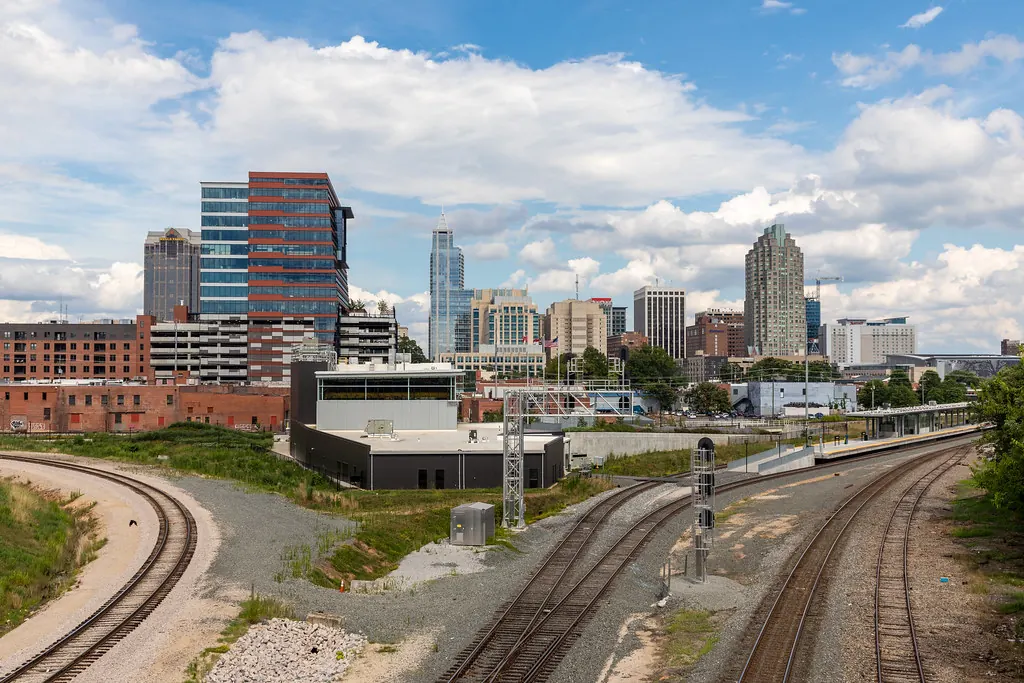
Raleigh at a glance
- Falling oaks
- Ice storms
- Spring tornadoes
- Hail bursts
- Winter pipe bursts
Housing: Raleigh mixes Victorian and craftsman homes in the historic core, mid-century ranches inside the Beltline and large HOA subdivisions and townhome communities toward Brier Creek, Wakefield and the county line.
Where we work: Oakwood, Five Points, Hayes Barton, Boylan Heights, Mordecai, North Hills, Glenwood-Brooklyn, Brier Creek, Wakefield
Why Raleigh losses rarely come down to one line item
Raleigh calls itself the City of Oaks, and the name is earned. Willow oaks and red oaks planted along streets in Five Points, Hayes Barton and Oakwood have grown well above the rooflines they shade. When a summer squall line or an ice event comes through, a single limb can open a roof, break rafters, crush a porch and take out a fence on the same lot. Those claims are seldom denied outright. The disagreement is almost always about how much of the house was actually affected and what it costs to put it back.
The city’s growth adds a second layer. Contractors in Wake County have stayed busy for years, and after a regional event their schedules fill quickly. An estimate built on generic unit pricing can look reasonable on paper and still fall short of what local trades will actually charge to do the work.
Housing stock that shapes the estimate
Inside the Beltline, many homes date from the 1910s through the 1950s. Plaster over lath, original heart-pine floors, wood windows with true divided lites and slate or standing-seam roofs all show up regularly. Oakwood, Boylan Heights and other locally designated historic districts can require review before exterior materials are changed, which affects both scope and timeline.
Farther out, the issues change. In newer subdivisions near Brier Creek and Wakefield, the questions are usually about matching: whether a discontinued shingle color or a faded vinyl siding profile can be patched without an obvious mismatch, and whether a partial replacement leaves the home in a reasonably uniform condition. Townhome communities add the HOA master policy, which may cover the structure while the owner’s policy covers interiors and improvements.
What we look at first
- Whether plaster walls and ceilings were priced as drywall.
- Roof decking, rafter repairs and framing hidden behind a tree strike.
- Tree removal and crane costs on tight in-town lots.
- Matching for siding, shingles and continuous flooring.
- Code-related items and historic-district requirements left out of the scope.
Disputes we see most often in Wake County
Many Raleigh appraisals start with a roof. One estimate calls for spot repairs; the other calls for replacement because brittle shingles cannot be lifted without breaking. Interior water losses are another frequent source of disagreement, especially in older homes where drying a plaster wall is a different job than cutting out and replacing gypsum board. Hail tends to come in narrow swaths here, so neighbors on the same street can end up with very different outcomes and very different estimates.
Appraisal is designed for exactly these amount-of-loss disagreements. When a policy contains an appraisal clause and either side invokes it, each party typically names its own appraiser, the two appraisers select an umpire, and a written award resolves the value of the loss. It does not decide whether a loss is covered; that remains between you and your insurer. We work as your appointed appraiser, as an umpire, or as an estimate reviewer before you decide whether appraisal makes sense at all.
Where we work around the capital
We handle Raleigh claims from Mordecai and Glenwood-Brooklyn to North Hills, Brier Creek and Wakefield, as well as surrounding Wake County towns such as Garner, Knightdale, Wake Forest and Holly Springs. If you are unsure whether your disagreement is a pricing question or a coverage question, a short call can usually sort that out.
Storm history around Raleigh
- 1996Hurricane FranFran’s winds brought down thousands of mature trees across Raleigh, crushing roofs and cutting power for days.
- 2000January snowstormA surprise storm buried Raleigh under roughly 20 inches of snow, a local record that collapsed carports and porch roofs.
- 2002December ice stormIce accumulation snapped limbs and power lines throughout Wake County, leaving much of the city without power.
- 2011April 16 tornado outbreakTornadoes tracked across the Triangle that afternoon, with heavy damage in parts of Raleigh.
Services available in Raleigh
Every North Carolina Insurance Appraiser service is available to property owners in Raleigh and across Wake County:
- Appraisal Panel Representation
- Residential Claim Disputes
- Commercial, HOA & Condo Claims
- Roof & Hail Loss Appraisal
- Wind & Tornado Loss Appraisal
- Hurricane & Tropical Storm Claims
- Water & Plumbing Loss Appraisal
- Fire & Smoke Loss Appraisal
- Ice Storm & Freeze Damage
- Carrier Estimate Audit
- Neutral Umpire Services
Questions from Raleigh property owners
Our Five Points home has plaster walls. Why does that matter in an appraisal?
Plaster over lath is slower and more expensive to repair than drywall, and blending a patch into an old wall takes skilled labor. When an estimate prices plaster rooms as standard gypsum board, the gap can be significant. An appraiser documents the existing materials and prices the repair that the home actually requires.
A tree from my neighbor’s yard fell on my Raleigh house. Can appraisal still help?
Often, yes. Your own homeowners policy usually responds to damage to your home regardless of whose tree it was. If your insurer accepts the claim but you disagree on the repair cost, including framing, roofing, interior damage and tree removal, appraisal may be available under your policy to settle the amount of the loss.
Does the HOA policy or my policy pay for storm damage to my Wake County townhome?
It depends on the governing documents and both policies. Many townhome associations insure exterior elements such as roofs and siding, while owners insure interiors and upgrades, but arrangements vary. We review both estimates against what each policy is actually responding to before valuing the loss, so nothing is double counted or left out.